
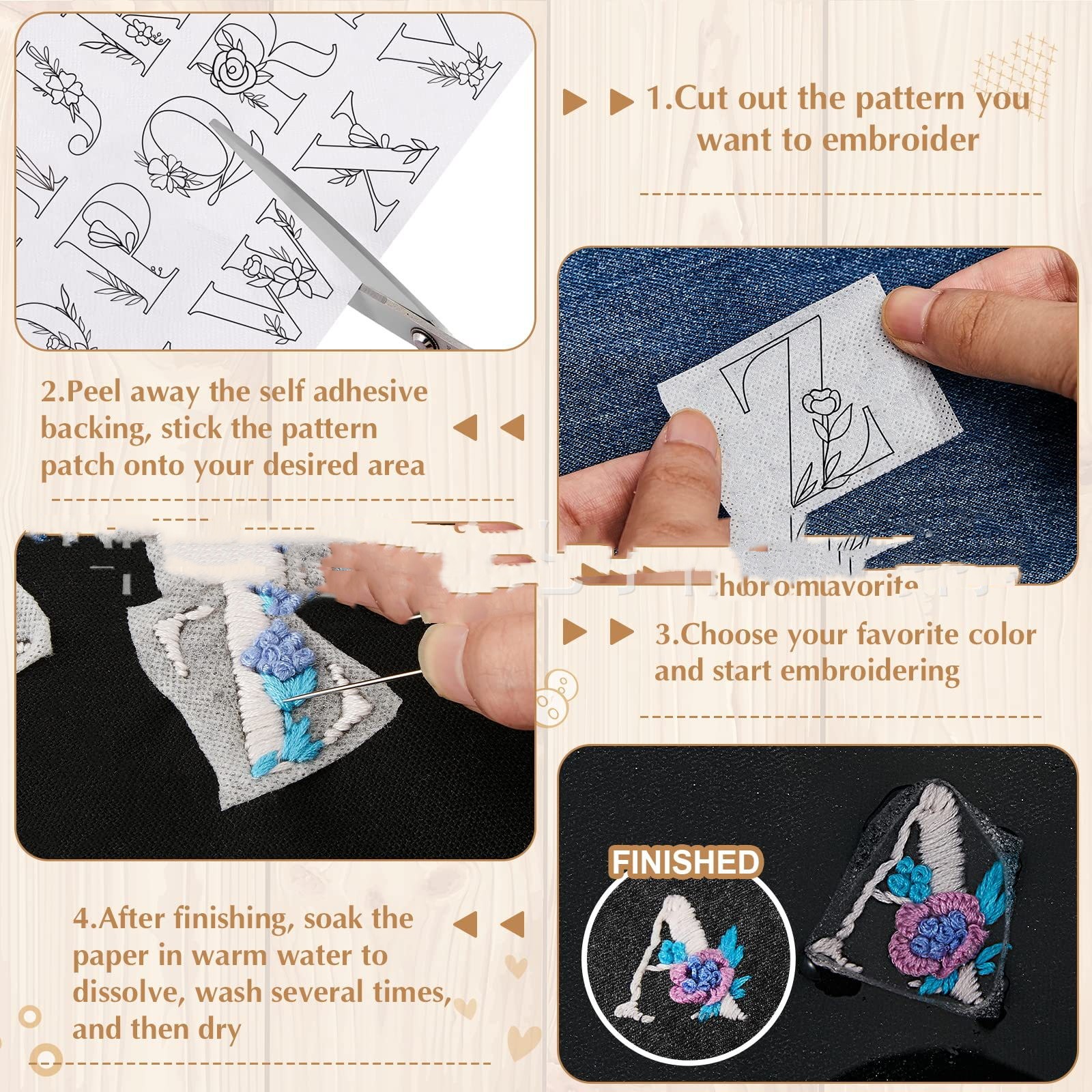
Transfer paper and stick-and-stitch solve the same problem in different ways. Transfer paper copies lines onto the fabric; stick-and-stitch puts the printed pattern on top of the fabric and lets you stitch through it.
If you want the fewest tracing steps on denim, dark fabric or a tote bag, stick-and-stitch is usually easier. If you want to reuse one paper pattern many times, transfer paper can be cheaper and faster.
How transfer paper works
Place colored transfer paper between the printed pattern and fabric, then trace the design with a stylus or dry pen. The pressure leaves a copy of the line on the cloth.
It works on fabric you cannot see through and comes in light colors for dark fabric.
How stick-and-stitch works
The design is printed on a thin adhesive stabilizer. Stick it to the fabric, embroider directly through the sheet, then dissolve the sheet in water after stitching.
It avoids tracing and can stabilize stretchy or textured fabric while you work.
Accuracy and fine detail
Stick-and-stitch preserves the printed line exactly as long as the sheet does not stretch during application. Transfer paper depends more on how carefully you trace, especially on tiny curves and lettering.
Cleanup and fabric limits
Transfer-paper marks vary by product: some brush away, some wash out and some can linger. Stick-and-stitch requires a thorough water rinse, so it is not ideal for fabric or thread that cannot get wet.
Always test the removal method on a scrap.
Cost and reuse
A sheet of transfer paper can often be reused for several designs, which is economical for repeated motifs. Stick-and-stitch is usually single-use but saves time because you do not trace the design by hand.
Best use cases
Choose transfer paper for repeated motifs, non-washable projects or when you want direct lines on the fabric. Choose stick-and-stitch for denim, totes, dark fabric, stretchy fabric and detailed motifs you want to place quickly.
FAQ
Is stick-and-stitch better than transfer paper?
It is easier for many dark, textured or finished items, but it requires washing. Transfer paper can be better when the fabric cannot be soaked or you want to reuse the pattern.
Does stick-and-stitch make the needle sticky?
Some adhesive residue can collect on the needle during long projects. Wipe the needle occasionally if needed.
Does embroidery transfer paper wash out?
It depends on the product. Some marks wash, brush or fade away; others are intended to be covered. Check the instructions and test first.
Can I print my own design on stick-and-stitch?
Many blank water-soluble stabilizer sheets are made for inkjet printing. Follow the specific product’s printer instructions.
What to do next
For a broader decision tree, see 5 Ways to Transfer an Embroidery Pattern and browse our pre-printed stick-and-stitch patterns.