
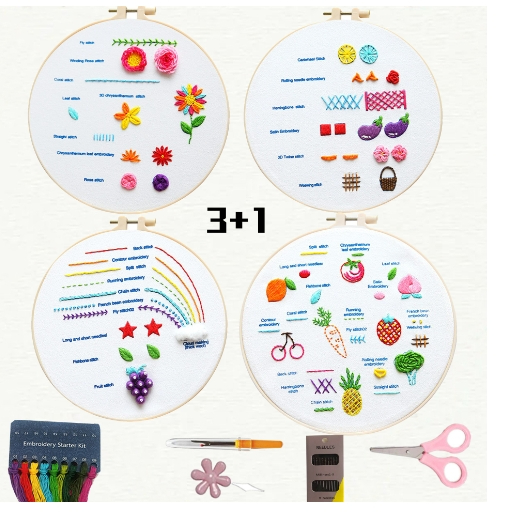
An embroidery stitch sampler is a practice piece with rows of stitches, usually printed with each stitch name beside it. Beginners should start with one because you learn one stitch at a time, on a low-stakes fabric, before you commit to a full design. You end up with a reference piece and much better control of your tension and stitch length.
This guide explains how a sampler works, why it helps, what to stitch first, and which of our kits are made for it.
What is an embroidery stitch sampler?
A sampler collects stitches on one piece of fabric. Traditional samplers were stitched to show off skill. Modern beginner samplers work more like a workbook.
In the Stitch Sampler Embroidery Kit, each of three pre-printed practice fabrics has rows of stitches with the stitch name printed next to each row. You work through them in order. One 20 cm (8 in) bamboo hoop is included, and you move each fabric into it in turn.
Why an embroidery stitch sampler helps beginners
You learn one stitch at a time
A full design mixes many stitches at once. That can be overwhelming when you are still learning to hold the needle. A sampler lets you repeat one stitch until it feels natural.
Mistakes cost less
If your first French knots come out lumpy, it only affects a practice row. Unpick it or leave it and move on. You can also stitch a row again, which is hard on a finished picture.
You build tension and rhythm
Even stitch length and steady tension are what make embroidery look neat. Rows of back stitch or satin stitch teach that better than reading about it.
You get a reference
When you finish, you have a piece that shows how each stitch looks. Later you can glance at it when a pattern says “stem stitch” and you have forgotten the steps.
You are ready for real kits
Many of our kits list stitches like satin stitch, back stitch and French knots. After a sampler, you will have tried these already. See the stitches listed on each kit page to pick your next project.
What to stitch first
Start with the simplest stitches and move to the fussy ones. A sensible order looks like this:
- Straight stitch and running stitch, to get used to the needle and thread.
- Back stitch, the base for most outlines.
- Stem stitch and split stitch, for curves and lettering. See back stitch, stem stitch and split stitch for the differences.
- Satin stitch for solid fills. Our guide to how to do a satin stitch covers the steps.
- Lazy daisy and chain stitch, for petals and loops.
- French knots for flower centers and texture. See how to do a French knot for steps and fixes.
- Longer stitches and fancier ones, once the basics feel comfortable.
You do not have to finish every stitch in one sitting. Many people do a row or two a day.
How to get the most from a sampler
- Keep the fabric drum-tight in the hoop. Our guide on how to use an embroidery hoop shows how.
- Use the strand count the kit suggests, and check the embroidery floss guide if you are unsure how to separate strands.
- Repeat a row on the blank space if you want extra practice.
- Do not worry about perfect results. Your tension will improve with each row.
- Keep the finished piece in a folder or frame it as a reference.
Which stitch sampler kits do we offer?
Our stitch sampler kits page lists the samplers currently available. Here are the two that fit this guide best.
Stitch Sampler Embroidery Kit
The Stitch Sampler Embroidery Kit includes three pre-printed practice fabrics, floss and needles for the practice set, a bamboo hoop, small scissors, a needle threader and a seam ripper. It covers stitches such as straight, running, back, satin, split, lazy daisy, chain, French knot and more. It is rated beginner, made for people who have never stitched.
Embroidery Stitch Sampler Set of 4
The Embroidery Stitch Sampler Set of 4 goes further, with four pre-printed practice fabrics, floss and needles, a bamboo hoop, scissors, a threader and a seam ripper. It covers 30+ stitches, including stem, fly, woven rose, herringbone and 3D stitches. It is also rated beginner.
Either kit works for a first purchase. The set of four gives more fabric to practice on. The three-fabric kit is a good start if you want a smaller step.
Can you learn stitches without a sampler?
Yes. A full kit teaches the stitches it uses, and many people learn that way. The sampler route just spreads the learning out.
If you prefer to go straight to a project, read how to embroider and embroidery stitches for beginners first. Then pick a beginner-rated kit from our beginner embroidery kits.
FAQ
What is a stitch sampler in embroidery?
It is a practice piece showing many stitches on one fabric. Beginner samplers print the stitch names beside each row.
How long does a sampler take?
It depends on how many rows you do per sitting. Work at your own pace and stop when your hands or eyes tire.
Do I need extra supplies?
The kits listed above include a hoop, scissors and a needle threader. Check each product page for what is in the box.
Should I stitch a sampler before a full kit?
It is not required, but it is a gentle way to start. You learn the stitches first and gain confidence.