
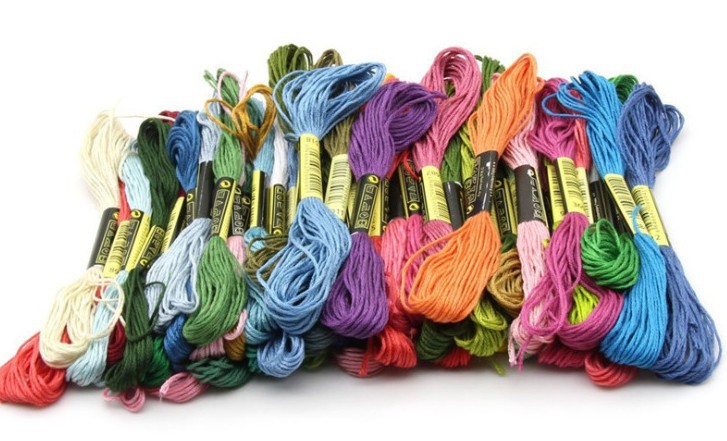
Embroidery floss is the thread you stitch with, and it looks simple until you open your first skein. It’s made of several thin strands twisted together, it comes in hundreds of colors, and patterns keep telling you to use “two strands” or “three strands.” This guide explains what floss is, how to choose it, how to separate and cut it, and how to keep your collection tidy.
What is embroidery floss?
Standard embroidery floss is six-strand cotton: six thin threads loosely twisted into one bundle. You pull apart as many strands as your design needs and stitch with those. That’s what makes floss so flexible. The same skein can make a fine, delicate line with one strand or a bold, raised line with all six.
Most floss is mercerized cotton, which means it’s been treated to be smoother and a little shiny. It’s colorfast in normal use, easy to pull through fabric, and inexpensive, which is why nearly every embroidery and cross stitch pattern is written for it.
A standard skein holds about 8 meters (roughly 8.7 yards). That’s enough for a small hoop in most colors. For large filled areas you may need a second skein of the main color.
Floss vs. other embroidery threads
- Six-strand floss: the everyday choice for embroidery and cross stitch. Divisible, so you control the thickness.
- Pearl (perle) cotton: a single, twisted thread that isn’t meant to be separated. It has a rope-like, glossy look and is common in sashiko-style stitching and bold outlines.
- Wool and crewel yarn: soft and fuzzy, used for crewel embroidery and textured pieces.
- Metallic and rayon threads: add sparkle or high shine, but they’re slippery and fray more. Save them for small accents.
If you’re starting out, stick with six-strand cotton. Everything in this guide is about it. New to stitching altogether? Start with our beginner’s guide to embroidery.
How many strands should you use?
Always follow your pattern first. If it doesn’t say, these defaults work for most beginner projects:
- 1 strand: very fine details, tiny lettering, hair and whiskers.
- 2 strands: outlines, small lettering and delicate flowers. The standard for cross stitch on 14-count Aida.
- 3 strands: a good all-round choice for back stitch, stem stitch and satin stitch on cotton or linen.
- 4 to 6 strands: bold lines, chunky French knots and anything that should stand out from a distance.
Two things to keep in mind:
- More strands fill faster but look less smooth. Satin stitch with six strands tends to twist and look lumpy. Two or three strands laid neatly look better.
- Split stitch works best with an even number of strands, because you pierce the middle of the previous stitch.
How to separate floss strands without tangling
This is the step that frustrates most beginners, and there’s a simple trick to it.
- Cut your length first (see below). Never try to separate strands straight from the skein.
- Find one strand at the cut end and pinch it between your thumb and finger.
- Hold the rest of the bundle in your other hand and pull the single strand straight up, slowly. The bundle will bunch and spin; let it. It untwists itself as the strand slides out.
- Repeat for each strand you need, one at a time.
- Put the strands back together side by side, then thread your needle.
Pulling strands out one by one and then recombining them is called “stripping” the floss. It makes the strands lie flat and parallel, so your stitches look fuller and smoother. It’s worth doing even when you use all six.
How long should you cut your floss?
Cut a piece about 18 inches (45 cm) long, roughly the distance from your fingertips to your elbow. It feels short at first, but longer pieces:
- tangle and knot more often,
- wear thin and fuzzy as they pass through the fabric again and again,
- slow you down, because you pull a long length through with every stitch.
Metallic threads should be cut even shorter, about 12 inches, because they fray quickly.
Reading floss labels and color numbers
Each skein has a paper band with a color number. Brands use their own numbering, and patterns usually list the brand and number for each color. A few tips:
- Keep the label until you’ve used the whole skein, or write the number on your bobbin. Similar shades are almost impossible to tell apart later.
- Colors vary between dye batches, so buy enough of your main color for a large project at the same time.
- You can substitute brands. If a pattern calls for a brand you don’t have, pick the closest shade by eye in daylight. Lay the floss on the fabric you’ll use, since the background color changes how a thread looks.
Building a floss collection
When you start stitching your own designs, a mixed set of colors saves a lot of trips to the store. Look for:
- One skein per color across the full range, including several greens, browns, grays and skin tones, which patterns use constantly.
- Six-strand cotton of standard skein length, so it works with any pattern.
- Clear labels on each skein.
Our embroidery floss set comes in 50 or 200 colors of six-strand cotton, 8 m per skein, one skein per color. If you’d rather not shop for colors at all, every one of our beginner embroidery kits includes exactly the floss the design needs.
How to store embroidery floss
Loose skeins tangle into a nest surprisingly fast. The easiest fix:
- Wind each color onto a bobbin. Plastic or card bobbins are cheap and fit into divided boxes.
- Write the color number on the bobbin before you remove the label.
- Store bobbins in a floss organizer box, sorted by color number or by color family.
- Keep it out of direct sunlight, which can fade colors over time.
For a single project, a simple ring or a strip of card with holes punched in it works well: loop each color through a hole and write its number beside it.
Common floss problems and fixes
- Thread keeps twisting and knotting: let the needle hang down every few stitches so the thread untwists, and use shorter lengths.
- Stitches look thin or gappy: you may be using too few strands, or the strands weren’t separated and recombined, so they’re twisted together.
- Floss looks fuzzy: the length is too long, or the fabric is very coarse. Cut a fresh piece.
- Colors bled when washing: rinse in cool water only and don’t soak for long. If you’re worried, test a snipped piece of floss in water first.
FAQ
What is the difference between embroidery floss and embroidery thread?
People often use the words for the same thing. Strictly, “floss” usually means the divisible six-strand cotton, while “embroidery thread” can mean any thread used for embroidery, including pearl cotton, wool and metallics.
How many strands of embroidery floss should I use?
Follow your pattern. If it doesn’t say, use two or three strands for outlines and satin stitch, two for cross stitch on 14-count Aida, and four to six for bold lines and big French knots.
Can I use embroidery floss for cross stitch?
Yes. Six-strand cotton floss is the standard thread for cross stitch. Two strands is the usual choice on 14-count Aida.
How much floss comes in a skein?
A standard skein of six-strand cotton floss is about 8 meters, or roughly 8.7 yards.
Can I use embroidery floss for friendship bracelets?
Yes. Six-strand cotton floss is the classic friendship bracelet thread, used with all six strands together.
How do I stop my floss from tangling?
Cut shorter lengths of about 18 inches, separate the strands one at a time, and let the needle dangle every so often so the thread can untwist.