
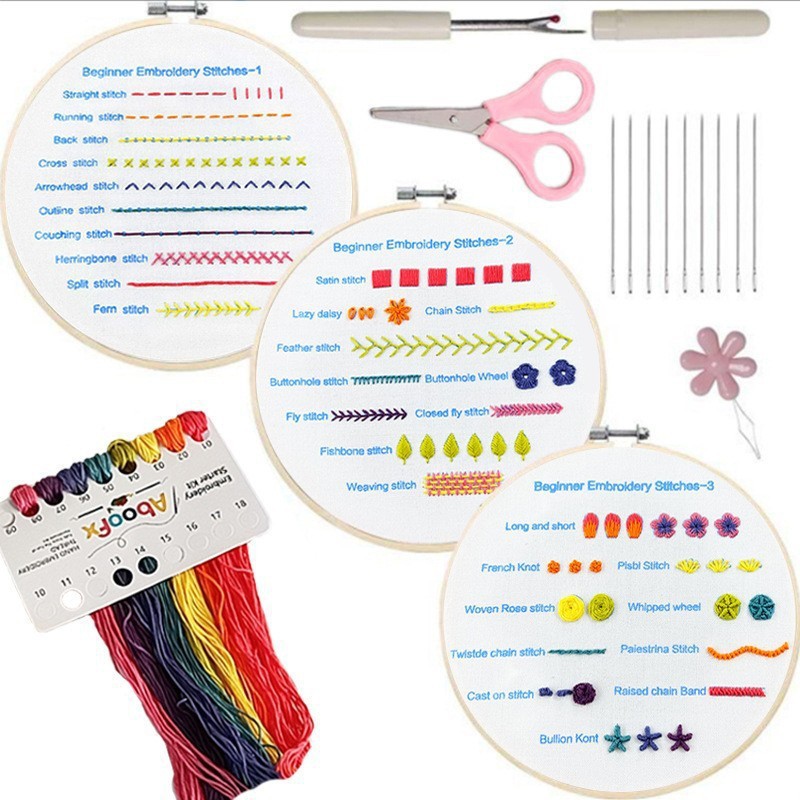
Running stitch and back stitch both make lines, but they solve different problems. Running stitch creates a dashed line; back stitch creates a continuous solid line. If you want a clean outline or lettering, back stitch is usually the better choice. If you want visible gaps, quick borders or a simple decorative rhythm, running stitch is faster.
Both are part of the 8 basic embroidery stitches beginners should learn first.
Running stitch in one sentence
Bring the needle up, move forward, go down, leave an equal gap and come up again. The front becomes a row of short stitches separated by spaces.
It is fast, flexible and easy to keep relaxed.
Back stitch in one sentence
Come up one stitch length ahead, then stitch backward into the end of the previous stitch. Each new stitch touches the last, so the front looks like an unbroken line.
Which is better for outlines?
Back stitch. It follows printed pattern lines clearly and works well around flowers, animals and lettering. Shorten the stitch length around tight curves so the line stays smooth.
Running stitch is better when the gaps are part of the design or when you deliberately want a lighter line.
Which is easier for a complete beginner?
Running stitch is mechanically simpler, but back stitch is only one step more complicated and is more useful on many beginner kits. Practice five running stitches, then five back stitches beside them to feel the difference.
Tension mistakes to avoid
Do not pull either stitch so tight that the fabric puckers. With back stitch, avoid very long stitches around curves. With running stitch, focus on even stitch and gap lengths instead of trying to make every millimeter perfect.
Can you combine them?
Yes. A running-stitch border can frame a solid back-stitched motif, or you can use back stitch for main outlines and running stitch for decorative details. Mixing line weight makes simple patterns more interesting.
FAQ
Is running stitch the same as back stitch?
No. Running stitch leaves gaps between stitches; back stitch connects each stitch to the previous one to make a solid line.
Which stitch is better for lettering?
Back stitch is usually better because it creates continuous, readable strokes.
Which stitch uses less thread?
Running stitch normally uses less because there are gaps on the front.
Can I use back stitch on curves?
Yes. Use shorter stitches as the curve becomes tighter.
What to do next
Practice both on a stitch sampler kit or work through all 8 basic stitches.