
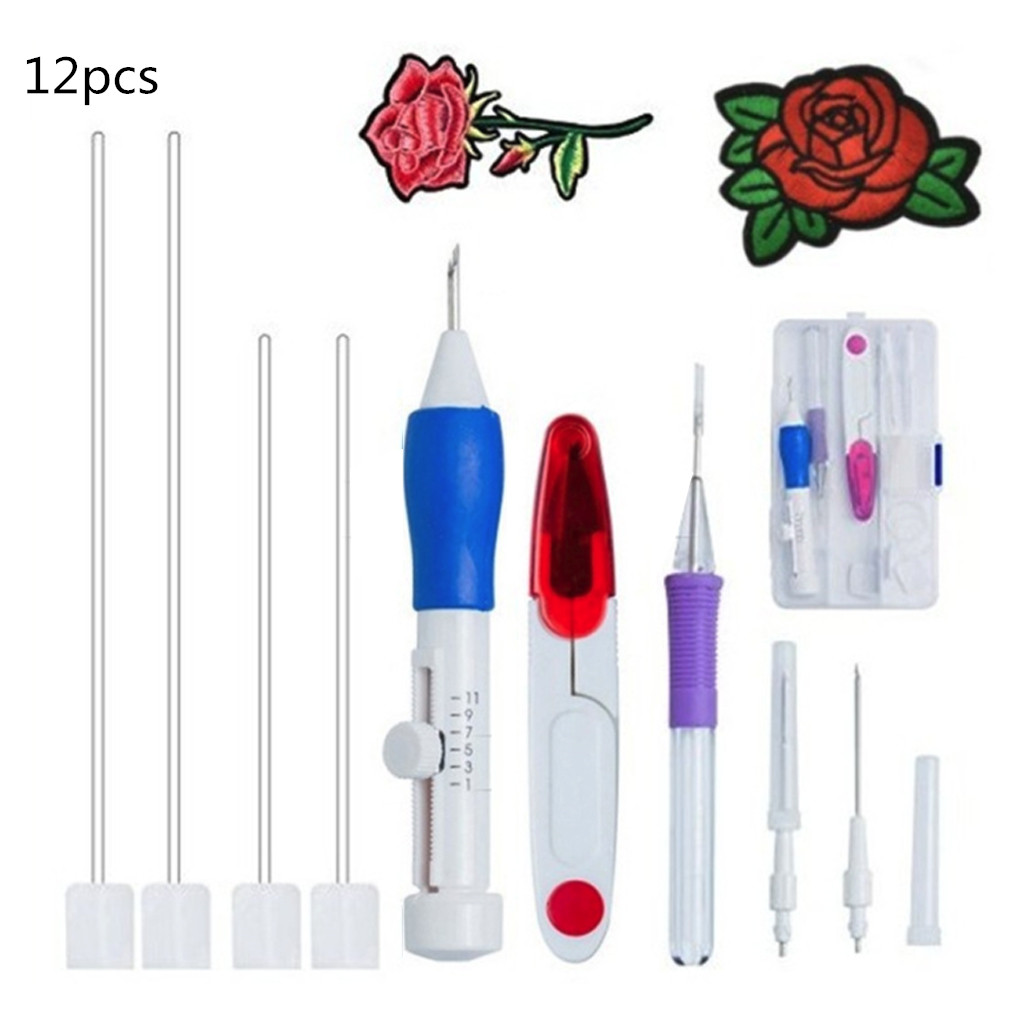
Most hand embroidery uses a sharp embroidery needle (also called a crewel needle) in a size between 3 and 9. The lower the number, the bigger the needle, so use a low number for many strands of floss and a high number for one or two strands. Chenille needles suit thick thread, and tapestry needles have a blunt tip for special jobs.
This guide explains the three main types of embroidery needles, how the size numbers work and how to match a needle to your floss.
The three main embroidery needles at a glance
| Needle | Point | Eye | Size range | Best for |
|---|---|---|---|---|
| Embroidery (crewel) | Sharp | Long and oval | 1 to 10 | Most floss embroidery on cotton and linen |
| Chenille | Sharp | Large and long | 13 to 28 | Thick thread, wool yarn, ribbon and heavier fabric |
| Tapestry | Blunt | Large and long | 13 to 28 | Counted work, weaving under stitches, not piercing fabric |
For a first kit, the sharp embroidery needle is the one to reach for. The long eye is made to carry several strands of floss at once, and the point slides between the threads of the fabric.
How embroidery needle sizes work
Needle sizes run the opposite way from what many people expect. A higher number means a thinner, finer needle.
- Embroidery needles: size 1 is the thickest and size 10 is the finest.
- Chenille and tapestry needles: size 13 is the thickest and size 28 is the finest.
- The same numbers can differ a little between brands, so treat any chart as a starting point.
The needle needs to make a hole big enough for the thread to pass without fraying, but not so big that it leaves visible holes in the fabric. That balance is why thicker thread needs a bigger needle.
Which embroidery needle size for how many strands?
Standard six-strand cotton floss splits into single strands, and your pattern will tell you how many to use. Match your needle to that number with this chart.
| Strands of floss | Embroidery needle size | Typical use |
|---|---|---|
| 1 | 8 to 10 | Fine detail, tiny lettering, delicate lines |
| 2 | 7 to 8 | Outlines, small lettering, detailed motifs |
| 3 | 5 to 6 | General stitching, satin stitch, lazy daisy |
| 4 | 4 to 5 | Bolder fills and thicker lines |
| 6 | 3 | Bold coverage and thick texture |
Treat these ranges as a guide, not a rule. A tightly woven fabric may want a slightly finer needle, and a loose weave can take a slightly bigger one. Your kit’s pattern guide is the best source for how many strands each stitch needs. For more on floss itself, see our embroidery floss guide.
Chenille needles: when to use them
A chenille needle has a sharp point like an embroidery needle but a bigger, rounder shaft and a large eye. It suits thick threads such as wool yarn, silk ribbon and several strands of perle cotton. The wider hole it makes also helps thick thread pass through heavier fabric.
Sizes 18 to 24 are common for embroidery. Use the lower numbers with the thickest yarn and the higher numbers with thinner threads. For everyday six-strand floss projects you rarely need one.
Tapestry needles: when to use them
A tapestry needle has a blunt tip. That makes it wrong for stitching through plain fabric, but ideal for jobs where you do not want to split or pierce anything.
- Counted work such as cross stitch, where the needle goes through the holes of the fabric. A size 24 is a common match for 14-count fabric.
- Weaving thread under existing stitches, as in woven stitches and whipped stitches.
- Sliding thread through the back of your stitching to finish off an end.
If you are curious about counted work, our cross stitch for beginners guide explains how it differs from embroidery.
How to choose the right needle in four steps
- Check your pattern for how many strands of floss to use.
- Choose the type. Use a sharp embroidery needle for most projects, and a chenille needle if the thread is thick.
- Pick the size from the chart above.
- Test it on a scrap or the edge of your fabric. The needle should pass through with light resistance and the thread should slide through the eye without shredding.
Signs you have the wrong needle
- The floss frays or shreds as you stitch. The eye is probably too small, or the needle is too fine for the number of strands.
- You have to tug the needle through the fabric. The needle is too thick for the weave, or too thin to open a path for the thread.
- You can see holes around your stitches. The needle is too large.
- The thread keeps slipping out of the eye. The eye is too big for the thread, so move to a higher size number.
- The needle catches and will not go in. You may be using a blunt tapestry needle on plain fabric.
Threading and caring for your needles
A needle threader saves time, especially with a fine needle and several strands. Our embroidery starter set includes needles, a needle threader and small scissors, and the stitch sampler kit includes a threader too.
Keep needles in a needle case or a piece of felt so they do not bend or get lost. Replace one that is bent, burred or scratchy. Avoid leaving a needle in your fabric between sessions, since it can leave a mark.
What about the needles in a kit?
Most of our embroidery kits list needles in the box. For example, the Aurora and Starry Night kit comes with 3 embroidery needles. Our product listings do not give needle sizes, so start with the needle in your kit and follow its pattern guide. If you want extras or a different size, browse our embroidery supplies.
Ready to pair your needle with floss? The embroidery floss set is six-strand cotton, and our supplies for beginners guide covers the rest of the kit. New to stitching? Start with how to embroider and the stitches for beginners guide.
FAQ
What size needle for 3 strands of embroidery floss?
A size 5 or 6 embroidery needle suits 3 strands for most fabrics. Go one size lower if the thread is hard to pull through.
What is the best embroidery needle for beginners?
A sharp embroidery (crewel) needle in size 5 or 6 is a versatile choice. It handles 2 to 3 strands, which is what many beginner patterns use.
Can I use a regular sewing needle for embroidery?
You can in a pinch, but the eye is usually too small for several strands of floss, and the thread may fray. An embroidery needle has a longer eye designed for floss.
What is the difference between a crewel and an embroidery needle?
Almost nothing. The names are often used for the same needle: sharp, with a long eye. The size numbers are the same too.
How often should I replace embroidery needles?
Replace a needle when it bends, feels rough or starts to snag the fabric or floss. There is no fixed schedule, since it depends on how much you stitch.