
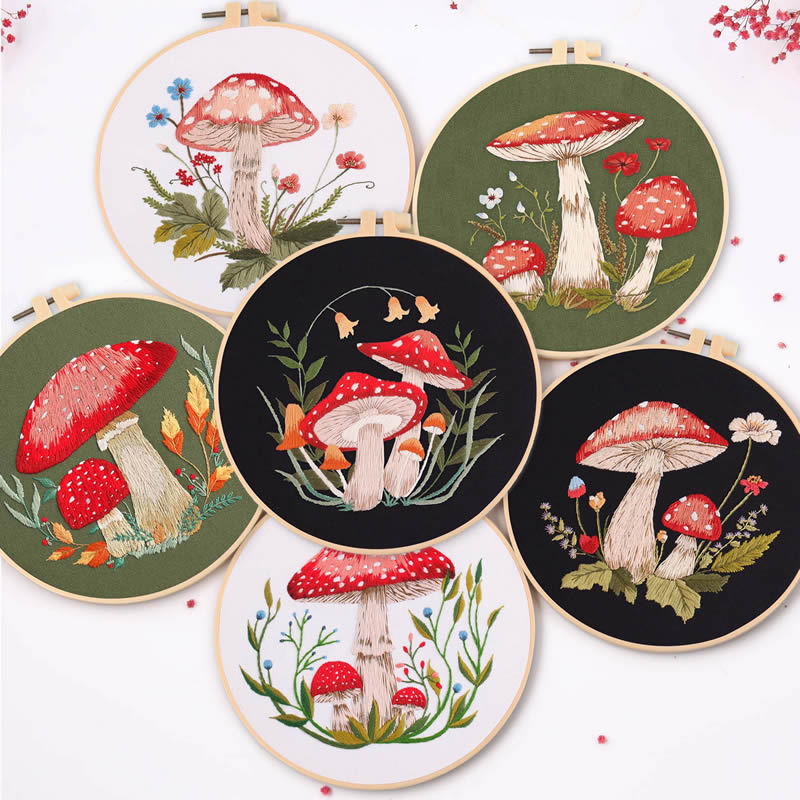
Mushroom embroidery is one of the easiest ways to get a cottagecore look in a hoop. A mushroom is a dome cap on a short stem, so you can stitch one with satin stitch for the cap and stem, back stitch for outlines, and French knots for spots and moss.
This guide covers motif ideas, stitch choices for each part of the mushroom, color palettes and two of our kits that include mushrooms. It also works if you just want to draw your own design on fabric and use what you have.
Why mushrooms suit beginners
The shapes are simple and forgiving. A cap does not need to be a perfect half circle, and a slightly wonky stem looks natural. Real mushrooms are irregular, so small mistakes read as character.
They also give you practice with the stitches beginners use most. Satin stitch fills the cap, back stitch draws details, and French knots add texture. If you want to build those skills first, see our guides on how to do satin stitch and how to do a French knot.
Mushroom embroidery ideas
The classic toadstool
A red cap with white spots on a cream stem. Fill the cap with red satin stitch, then add the spots as small French knots, tiny satin stitch ovals or seed stitches in white. Add a few short straight stitches under the cap edge for gills.
Cluster of small mushrooms
Three to five mushrooms of different heights look more natural than one. Vary the cap sizes and angle a couple of them to lean. Fill the gaps at the base with short straight-stitch grass or a few French knots for moss.
Wild forest mushrooms
Use different shapes for variety. Chanterelles are funnel-like with a golden color, and morels have an elongated honeycomb cap that you can suggest with brown satin stitch and small back stitch ridges. Flat, wide-capped mushrooms are easy to stitch as a long, low satin stitch shape. As with any wild mushroom, this is about decoration only, and you should never identify or eat mushrooms from a stitched pattern.
Mushrooms with ferns and flowers
Add a fern next to a mushroom to fill the space. A fern is one long stem in back stitch or stem stitch, with short straight stitches or fly stitches coming off it in pairs. Small bellflowers can be lazy daisy petals on a curved stem.
Moon and mushroom scenes
A small moon above a cluster of mushrooms gives you a night-in-the-woods scene. Stitch the moon in pale cream or silver-gray and scatter a few tiny stars as French knots. This works especially well on dark fabric.
Which stitch for which part
- Cap: satin stitch. Work the stitches in the same direction, either following the curve from the center out or straight across, and keep the edges neat with a back stitch outline first if you like.
- Stem: satin stitch worked across the stem, or long and short stitch for a shaded look.
- Gills: short straight stitches under the cap, or a few lines of back stitch.
- Spots and moss: French knots. One wrap gives you a small dot, two wraps a larger one.
- Grass and fern fronds: straight stitches and fly stitches.
- Outlines and thin details: back stitch or stem stitch. Back stitch is the easiest for beginners, stem stitch gives a smoother curve, and split stitch a rope-like line.
For a broader look at stitch options, see embroidery stitches for beginners.
Tips for a smooth cap
The cap is the biggest fill, and it is where satin stitch gaps show. A few habits help.
- Outline the cap with a small back stitch first so you have a clean edge to stitch up to.
- Use two or three strands of floss rather than all six. Fewer strands lie flatter and are easier to keep smooth.
- Bring the needle up and down right at the outline edge, so the stitches touch it on both sides.
- Keep the stitches parallel and fairly close together. Do not pull too tight or the cap will pucker.
- For a large cap, split it into two sections and stitch each one separately.
Cottagecore color palettes
- Classic toadstool: red, cream, brown and olive green.
- Warm autumn: ochre, rust, mustard and deep brown.
- Soft woodland: sage, dusty pink, cream and pale gray.
- Midnight forest: black fabric with cream, dusty red, moss green and gold.
Fabric color matters as much as floss. Cream feels traditional and bright, olive feels like moss and forest, and black makes light colors stand out.
Mushroom kits we carry
The Mushroom Embroidery Kit for Beginners (Cottagecore) has little toadstools, bellflowers and ferns on cream, olive green or black fabric. The printed cotton fabric is 30 by 30 cm (12 by 12 inches), and it comes with embroidery floss, 2 needles, an illustrated stitch guide and an imitation-bamboo hoop, 20 cm (8 inches). It uses satin stitch, back stitch, French knots and lazy daisy, and it is rated beginner.
The Highland Cow, Frog and Moth Embroidery Kit for Beginners is a different mix of modern animal designs. It includes a frog with the moon and mushrooms, along with a highland cow, a luna moth, a monarch butterfly, cat portraits and a stitch sampler. It comes with pre-printed fabric, floss, needles, a hoop and a pattern card with a color guide, and it is rated advanced beginner because the cow uses a lot of long stitches.
To compare options, browse the embroidery kits collection. If you want to practice stitches before a full design, the Stitch Sampler Embroidery Kit has printed practice fabrics with stitch names beside each row.
Finishing and displaying your mushrooms
A finished mushroom hoop looks good as it is. Trim the fabric, gather it behind the hoop and add a backing. Our guide to finishing an embroidery hoop shows how to back it, hang it or frame it. If you are new to hoops, how to use an embroidery hoop covers tension and setup.
FAQ
Is mushroom embroidery good for beginners?
Yes. Mushrooms use simple shapes and common stitches, and small irregularities look natural. A kit with a pre-printed pattern makes it even easier.
What stitch do I use for a mushroom cap?
Satin stitch is the usual choice. Outline the cap first, then fill it with parallel stitches that meet the edge cleanly.
How do I stitch the white spots on a toadstool?
Use French knots, small satin stitch dots or seed stitches in white. French knots add the most texture.
Can I embroider mushrooms on black fabric?
Yes. Light and bright floss shows up well on black, and a cottagecore mushroom kit is available on black fabric as one of its options.