
Uneven stitches usually are not a talent problem. They come from changing several variables at once: stitch length, fabric tension, thread tension and needle angle. Make those variables more consistent and your embroidery immediately looks cleaner.
The goal is not machine-perfect stitching. Handmade work should still look handmade. You are aiming for a rhythm that makes neighboring stitches feel related.
1. Tighten the fabric before fixing the stitches
Loose fabric moves under the needle and makes every length harder to judge. Tighten the hoop until the fabric feels firm, then smooth wrinkles before stitching. Our hoop guide explains setup in detail.
2. Mark a few guide points
For a border or repeated stitch, mark small dots at the intended spacing. You do not need to draw every stitch; a few reference points train your eye and keep the rhythm steady.
3. Shorten stitches on curves
A long straight stitch cannot follow a tight curve. Use shorter stitches as the line bends and slightly longer ones on straight sections. The line will look smoother even though the stitches are not identical in length.
4. Pull to ‘snug,’ not tight
Stop pulling when the thread lies flat against the fabric. If the cloth puckers or the stitch cuts into the weave, the tension is too high. Consistent moderate tension matters more than tightness.
5. Let twisted floss relax
Every few stitches, drop the needle and let it spin until the floss untwists. Twisted strands bunch together and make one stitch look thicker than the next.
6. Use the right number of strands
Very thick floss makes tiny spacing errors more visible. Two or three strands are easier to control for fine outlines; use more only when the design needs a bold line.
7. Practice one stitch in rows
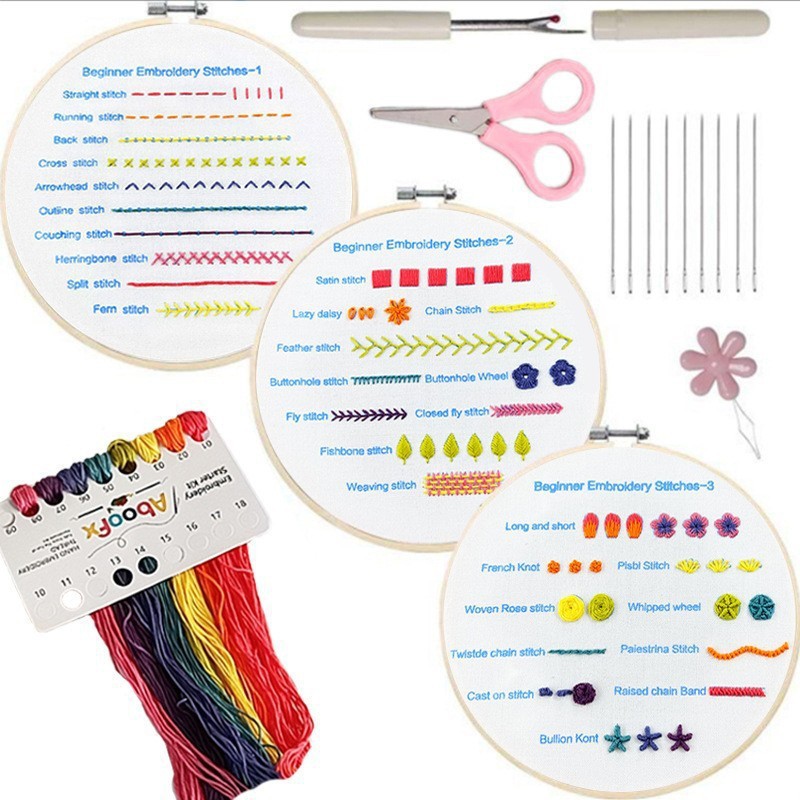
A stitch sampler is useful because you can repeat the same movement ten or twenty times without worrying about finishing a picture. Muscle memory develops faster when the variable is just the stitch itself.
FAQ
Why are my embroidery stitches different sizes?
The most common causes are loose fabric, inconsistent guide spacing and using stitches that are too long on curves.
Should embroidery stitches all be the same length?
Not always. On curves, shorter stitches often look more even than forcing every stitch to the same measured length.
Why does my embroidery fabric pucker?
The hoop may be loose or you may be pulling the floss too tight. Keep the fabric firm and the thread only snug.
Does a stitch sampler actually help?
Yes. Repeating one stitch in rows builds consistent hand movement without the distraction of a complex design.
What to do next
Build that rhythm with the 8 basic stitches guide or use a printed stitch sampler kit.